Category: Newsletter

  • Kick-Starting Formative Feedback with AI: CERs and Formative Assessment for OpenSciEd

    Last week, we hosted a Coaching ScienceLast week, we hosted a small Coaching Science Lab with educators, instructional coaches, and district leaders to explore a simple, open-ended question:

    What becomes possible when we use everyday AI tools to look more closely at student thinking—without changing who’s in charge of instruction?


    Experiences from the classroom

    Val shared how she used student drawings and explanations from the OpenSciEd Grade 8 Sound Waves unit to better understand student thinking, generate feedback more efficiently, and decide what to teach next.

    Val’s classroom workflow:

    • student work as the starting point
    • generated feedback in the form of strengths and questions to push learner forward
    • AI support enabled her to provide feedback that directly referenced their work, and to do it a lot faster than would have been possible otherwise

    Students loved specific, concrete feedback.


    Using everyday AI tools on purpose

    For the hands-on, we practiced student feedback using off-the-shelf AI tools like ChatGPT, Claude, and Gemini to show how you can get started without any special tools.

    Participants could see exactly:

    • how to prompt the AI with student instructions, reviewer instructions, and student work
    • what the AI produced
    • how to chat with the AI to go deeper

    This demystified the AI and showed how it can be used for really helpful analysis on real student work.

    The real leverage wasn’t the tool.
    It was the thinking around:

    • what counts as evidence in student work
    • what feedback actually helps students improve
    • what patterns matter for coaching and planning

    AI simply helped us move through that thinking faster.


    Teacher judgment stays at the center

    A strong theme throughout the session was role clarity.

    Participants resonated with an approach where:

    • teachers review and revise all feedback
    • tone and instructional intent remain human
    • AI suggestions are visible, editable, and contextual
    • patterns support coaching conversations rather than replace them

    The framing that stuck was simple:

    Teachers hope to engage students in deeper, more feedback.
    AI helps teachers do that work more often, with less friction.


    An invitation, not a conclusion

    Participants in the Coaching Science Lab session showed creativity and curiosity, encouraging us to create more opportunities for shared practice around real student work.

    We’re excited to continue learning and doing together.


    Want to explore this yourself?

    If you’re curious to try this approach in your own context, we’ve shared two lightweight entry points:

    This is a great a place to start exploring.


    We’re continuing to host small Coaching Science Labs as spaces to test ideas, learn from real classrooms, and figure out what responsible, useful AI support can look like in practice.

    If you’re interested in joining a future session—or just trying this on your own—we’d love to learn alongside you. Browse or subscribe to our calendar to join us for upcoming events.
  • Eddo July Update – Teacher Tools in Motion

    Dear Friends of Eddo,

    We have been cooking some fun stuff over the past few months and here’s some exciting ones we’d like to share with ya’ll for the summer!

    Introducing the Eddo Workspace

    After wrangling with various use cases and pilots, we’ve found a sweet spot that supercharges teachers in their assessment feedback

    The Eddo Workspace is a platform that supports administrators and teachers in their adoption of OpenSciEd, assisting in time-intensive teacher tasks through technology. You can access our demo to explore how this supports teachers’ assessment evaluation work. 

    Mark your calendar! We will launch the beta version at the end of August ‘25, ready for the next academic year pilots. 

    Additional features coming up:

    • List of assessment materials from OpenSciEd units, editable to your school’s instructions and rubric
    • Feedback customization and sharing through PDF or email

    Our work with Wauwatosa: supporting assessment feedback

    This past year’s collaboration with Wauwatosa led to a successful OpenSciEd pilot and we are excited to extend this collaboration into the next academic year. We’ve have also collaborated and submitted an SBIR grant to help scale this work 🤞🏽.

    Interested in pilots and working with us? We’d love to connect!

    We are planning for an informal session on pilots and our workspace. Join us! Reach out to howdy@eddolearning.com

    Interesting challenges we have wrangled with: 

    • Giving teachers insights and resource access with Digital Teachers’ Edition
    • Answering questions and surfacing relevant materials through Teacher Assistant Chatbot for 30+ teachers

    We are grateful to be building this work alongside educators, and every connection helps us keep the focus where it belongs: empowering educators to co-create world-class, innovative instruction.

    Thank you, as always, for being part of our learning community.

    Team Eddo

  • Analyzing Student Work

    Analyzing Student Work

    Accelerating Coaching & Collaboration with AI: Supporting OpenSciEd Biology in Wauwatosa

    Featuring district-wide OpenSciEd implementation with a spotlight on High School Biology

    In our inaugural workshop, we explored how Wauwatosa educators are using AI to improve science instruction and equity. They’ve seen measurable gains in mastery—especially among Black students—through untracked classes and rigorous, NGSS-aligned instruction with OpenSciEd.

    We shared a mini-app we co-created that uses AI to:

    • Support teacher discussion and norming
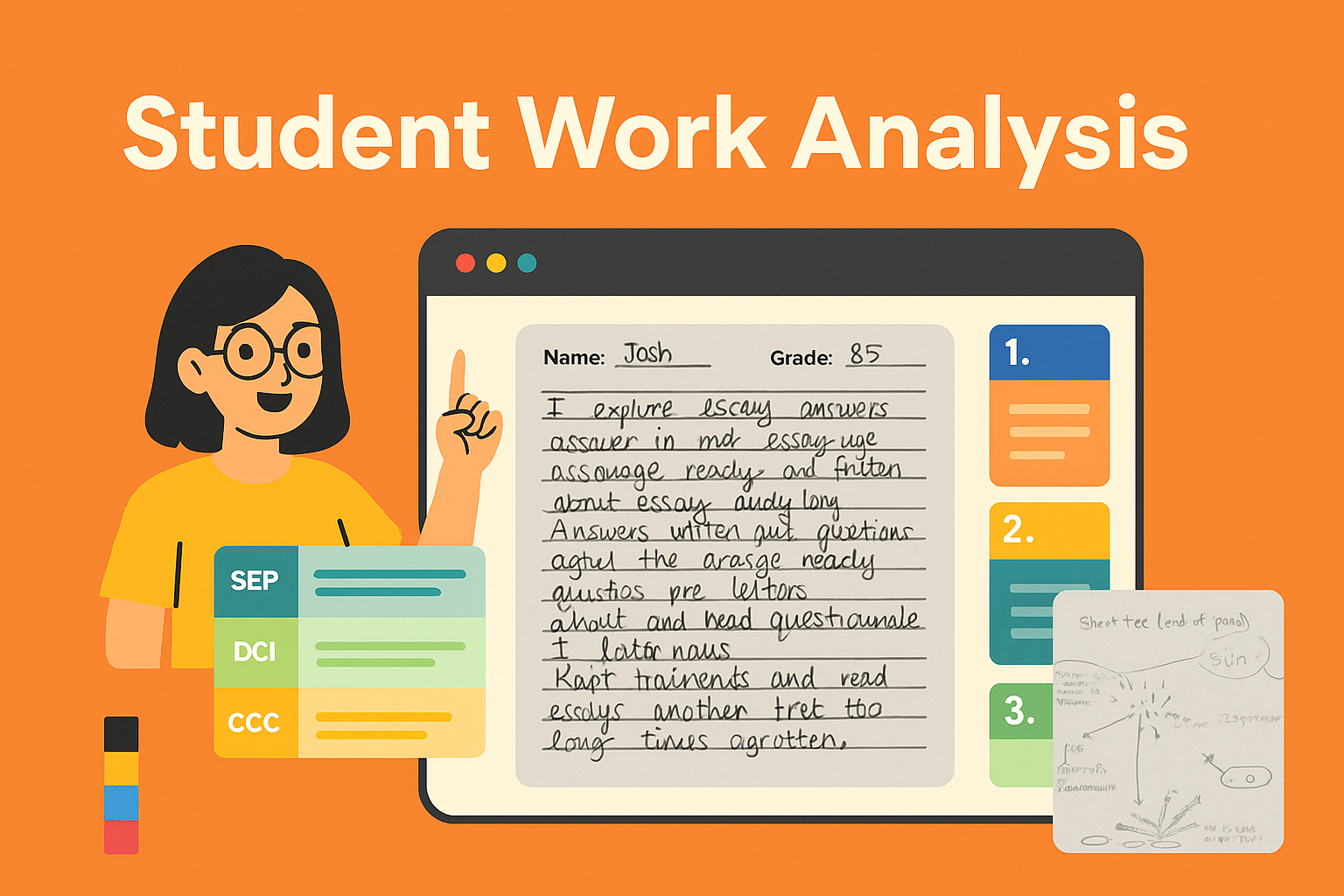
    • Analyze student writing (even from scanned handwriting)
    • Provide instant, rubric-aligned feedback
    • Surface strengths and areas for growth

    💬 Teachers shared: “This made my feedback better.” “It helped me see through the writing to what students understood.”


    Workshop Highlights:

    • ​How Wauwatosa used AI to support teacher collaboration and instructional coaching
    • ​A walkthrough of tools designed to generate real-time feedback aligned to OpenSciEd Biology
    • ​Practical takeaways for supporting system-wide implementation through PLCs and coaching models.
    Download Slides

    ​Presenters:

    Sarah Blechacz, Ed.D., K-12 Science Curriculum Coordinator

    Rachel Duellman, M.Ed., Instructional Coach

    ​Wauwatosa School District, Wauwatosa, WI

    Matthew Anthes-Washburn, M.A.T., Eddo Learning co-founder


    Accelerating Coaching & Collaboration with AI: The Wauwatosa Story

    In Wauwatosa School District, science leaders Sarah Blechacz and Rachel Duellman have been working to implement OpenSciEd with a coaching-centered model and a strong emphasis on data-driven equity. Their early outcomes show measurable gains in mastery for Black students, without sacrificing progress for others.


    🏫 The Wauwatosa Journey

    Wauwatosa Public Schools has been deeply engaged in a multi-year adoption of the OpenSciEd curriculum. Their approach is supported by coaching and collegial inquiry .

    Key milestones:

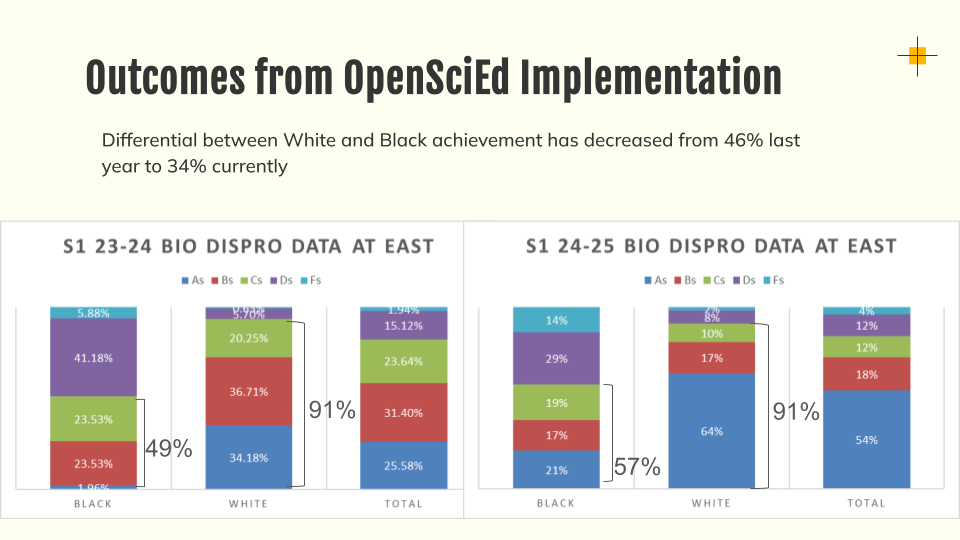
    • Equity-focused implementation: Mastery among Black students grew from 49% to 57%.
    • Detracked courses: Removed “advanced” biology and chemistry tracks to provide rigorous learning for all students.
    • Instructional shift: Tasks now emphasize modeling, design, and student-generated explanations.

    📈 Equity Gains in Student Outcomes

    Bar chart showing Black and White student grade distributions in high school biology at East High for two years. After OpenSciEd implementation, more Black students earned A–C grades, and the achievement gap with White students narrowed.
    After one year of OpenSciEd implementation, the percentage of Black students earning A, B or C grades in Biology rose from 49% to 57%, reducing the achievement gap with White students from 46% to 34%.

    🤖 Why Bring in AI?

    Wauwatosa’s teachers were seeing a huge increase in student writing—authentic, multi-paragraph explanations tied to rigorous phenomena—but it came with a cost: feedback and grading took much longer. Sarah and Rachel partnered with Eddo Learning to explore whether AI could help close that feedback loop faster and more equitably.


    🧠 Co-Designing AI Tools with Teachers

    The Wauwatosa team collaborated with Eddo Learning using a design thinking approach. They identified high-leverage teacher pain points, prototyped a feedback tool, and tested it with real student responses. The goal? Amplify what teachers are already doing and make high-quality feedback more accessible to students in real time.


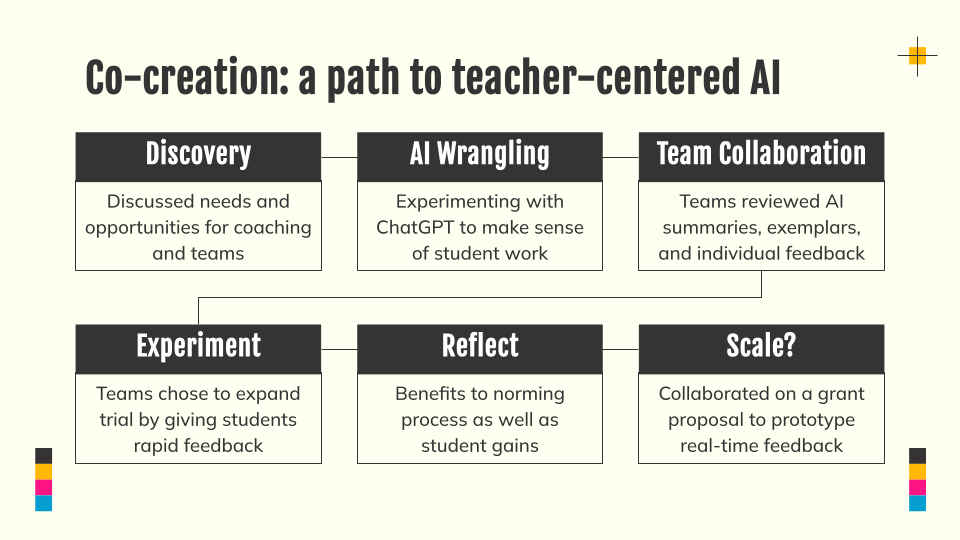
    Flowchart titled "Co-creation: a path to teacher-centered AI" with six steps: Discovery, AI Wrangling, Team Collaboration, Experiment, Reflect, and Scale? Each box describes an action taken by educators integrating AI into their coaching and feedback process.
    This co-creation process shows how educators collaborated to explore AI tools for student feedback. Starting from discovery and AI experimentation, teams reflected on student impact and proposed scaling the work through a grant.

    💬 What the AI Did

    The prototype AI assistant analyzed student writing samples, provided rubric-aligned strengths and suggestions, and helped teachers spot class-wide trends. One teacher noted that seeing the AI’s language helped improve her own feedback to students. Others used it to norm grading more effectively across PLCs.


    🛠️ Try It Yourself

    Curious to see what’s possible? Visit apps.eddolearning.com and explore the “Analyze Student Work” tool. You can upload student writing, view AI feedback, and even ask the data questions like “What misconceptions are most common?”


    🚀 What’s Next?

    The next workshop will focus on AI-supported lesson planning with OpenSciEd. We’ll explore what happens when ChatGPT already knows the curriculum and can help teachers visualize and pace a unit. If you’re interested in co-creating the next tool or leading a session, let us know!